
 English
 简体中文
简体中文
 Русский
 Français
 Português
 العربية
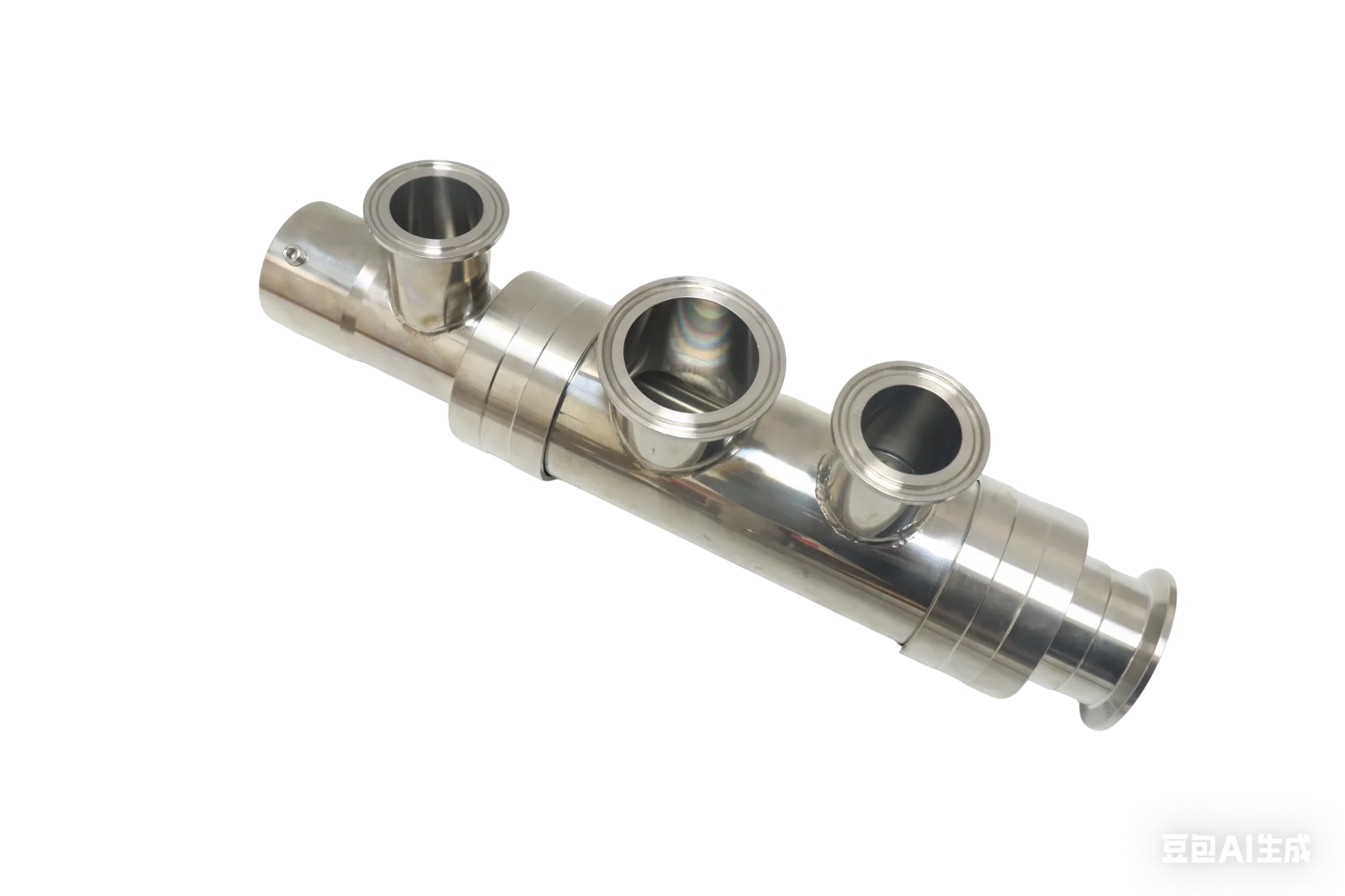
- Plug valves
- 4 min de lectura
How does a stainless steel manual sanitary plug valve work on a production line?
A stainless steel manual sanitary stopcock valve acts like a rotary switch installed on a production pipeline. Its core operation relies on manual
A stainless steel manual sanitary stopcock valve acts like a rotary switch installed on a production pipeline. Its core operation relies on manual
rotation of the handle to precisely control the flow, stop, or change direction of materials within the pipeline.
It mainly consists of the following components:
Operator: The production line worker who issues commands by rotating the handle.
Executor: The stopcock inside the valve body, a conical or cylindrical metal plug with a fluid passage, is the direct actuator responsible for actually
connecting or disconnecting the pipeline.
Passage: The internal cavity of the valve body used to guide the flow of materials.
Safeguard System: Includes sealing structures, quick-release clamps, etc., ensuring a leak-proof seal during production and easy disassembly and
cleaning.
Core Working Principle: Rotate 90° to control materials.
You can think of it as a faucet, but its "on/off" operation is more standardized. Inside the valve is a rotatable "stopcock" with a through-hole. To
achieve its function, two steps are required:
Activation (Opening): When you rotate the external handle to a position parallel to the pipe, the internal stopcock rotates simultaneously,
aligning its passage with the inlet and outlet at both ends of the valve body. Material can then flow through the valve without obstruction.
Closing (Cutting Off):When you rotate the handle 90 degrees to a position perpendicular to the pipe, the internal stopcock rotates
accordingly, completely blocking the previously aligned passage and preventing further material flow.
This simple 90-degree rotation is precisely what makes the stopcock valve quick to open and close and easy to operate.
How it Works: Standard Operating Procedures in Production
On the actual production line, operators follow a rigorous set of operating procedures:
Pre-Operation Inspection: Before operating the valve, the operator must inspect it to ensure its appearance is intact and observe the direction of
the groove on the handle or valve stem to determine whether it is currently in the open or closed state.
Manual Rotation (Core Operation):The operator holds the valve handle and rotates it 90 degrees clockwise or counterclockwise to open/close the
valve. When operating, use a handwheel or handle. Do not use a lever or have multiple people force the valve. Apply force smoothly to prevent
damage.
Status Confirmation and Fine-tuning: Confirm the valve is fully open or fully closed by observing the direction of the groove on the top surface of
the handle or valve stem. Then, turn the handwheel back 1/4 turn to prevent the threads from jamming.
Application Examples: It's More Than Just a Switch
Beyond simple "on/off," plug valves can achieve complex circuit control. Common types include "two-position three-way" or "two-position
four-way" plug valves, which can switch material flow from one pipeline to another or open multiple outlets simultaneously. In production lines,
it is often used in: Dairy/Food Production: On milk and juice production lines, when the raw material tank is full, the operator rotates the handle
90 degrees to switch the flow direction of the three-way plug valve, switching the material from the "feed" pipeline to the "packaging" pipeline.
Pharmaceutical/Biotechnology: In pharmaceutical workshops, stopcock valves are used to control the flow of critical media such as water for
injection (WFI) and pure steam (PS) in pipelines. Their dead-angle-free design and ease of CIP/SIP cleaning are key guarantees of GMP compliance.
Beverage/Beer Industry: During CIP cleaning, stopcock valves are used as "control points" on the cleaning station pipelines. Small-angle valve
opening (throttling) allows for precise control of the cleaning fluid flow and pressure, ensuring effective cleaning.
Production Line Advantages and Application Value:
Safety Assurance: The valve core's tapered seal has a "wiping" effect during rotation, automatically removing surface residues, ensuring sealing
performance, and preventing material leakage. The stainless steel material also withstands high temperatures, high pressures, and chemical
corrosion.
Maintenance Enhancement: Simple structure, easy disassembly and maintenance, and rapid "online maintenance" significantly reduce production
line downtime. Supports CIP in-situ cleaning and SIP in-situ sterilization, enabling efficient cleaning without disassembly. Workers only need to
operate the handle to perform on/off and switching functions.
A complete range of products: Available in various structural forms such as straight-through, tee, and four-way, as well as multiple connection
methods including quick-connect clamps, threaded connections, and welded connections, flexibly adapting to different production pipeline
designs.
Valves act as flexible "traffic controllers" in the production line. Through a core manual 90-degree rotation, they precisely and safely control the
conveying, switching, and stopping of materials, making the control of complex pipelines intuitive and reliable.
Siga leyendo
-
-
- Plug valves
- 3 min de lectura
How to select stainless steel sanitary PLUG VALVE for beverage applications
-
- Plug valves
- 1 min de lectura
What Are The Main Advantages of Using Stainless Steel in Sanitary Plug Valves?
-
- Plug valves
- 2 min de lectura
Comparison of stainless steel sanitary plug valves for food processing