
 English
 简体中文
简体中文
 Русский
 Français
 Português
 العربية

- Dairy
- Australia
- 2024
Stainless steel rusting in coastal air
Stainless steel rusting in coastal air is usually read as a grade problem, and usually it is not one. At an Australian dairy within sight of the sea, 304 supports were spotting brown inside two years — and what fixed it was not a more expensive steel.
Where the steel sits
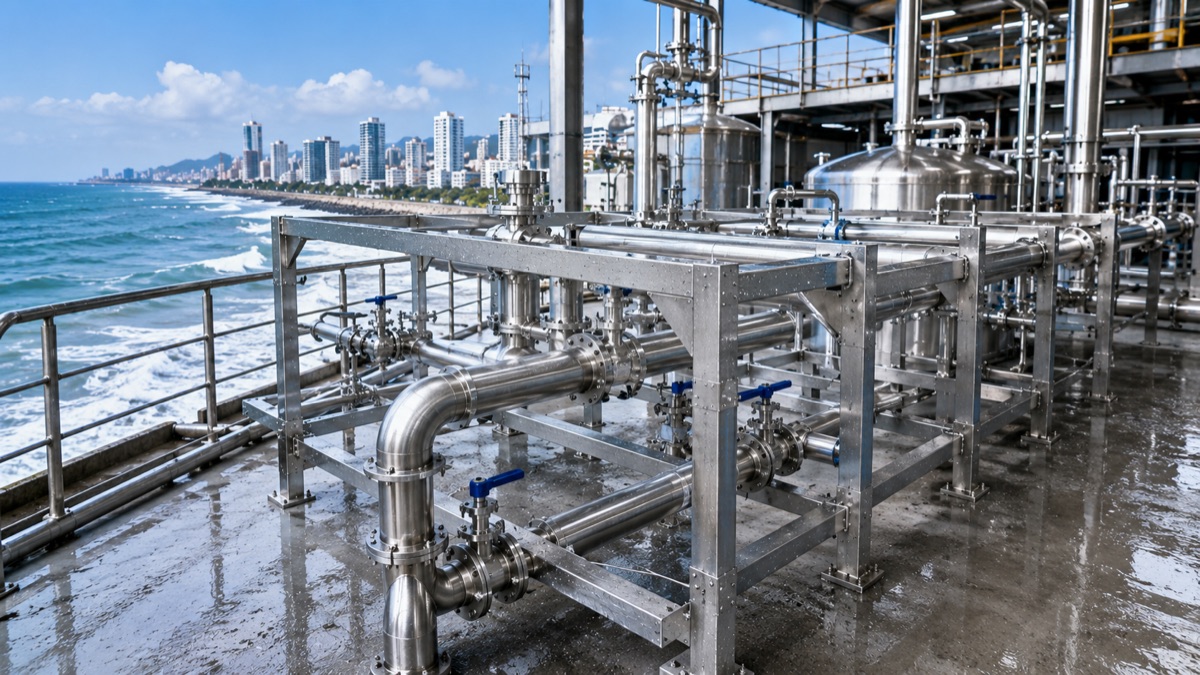
A dairy is a stainless steel building with milk moving through it. Raw milk is received and stored, pasteurised, homogenised, fermented and filled, and every one of those steps is piped. What holds the pipe up is not glamorous: pipe supports, equipment feet, platform frames. But it is the skeleton the whole line hangs on, and it stands inside the same hygienic envelope as the product.
This plant processes dairy on the Australian coast. The distance from the water is the whole story.
Where stainless steel rusting in coastal air starts
Stainless is not inert. It is protected. The protection is a chromium oxide film a few atoms thick, which forms on the surface and re-forms when it is scratched. As long as that film is dense and continuous, air and water never reach the metal underneath.
Chloride gets through it. Salt spray off the sea carries chloride ions, which are small and strongly polar. They settle on the surface, work into the film, and react with the metal to form soluble chlorides. The film dissolves locally rather than evenly, and where it dissolves a pit starts. Once a pit starts it sustains itself, because the chemistry inside a pit is more aggressive than the chemistry outside it.
Less than two years after commissioning, supports that had gone in bright were carrying brown spotting and visible pitting. The plant's problem was not how they looked. Rust on a support above an open tank or a conveyor is a foreign body waiting to flake off. A third-party food safety audit wrote the supports up as unclean equipment surfaces requiring rectification. Behind that, the pitting was eating into load-bearing section, and some of the supports had begun to deform.
What we supplied
The grade did not change. The surface did.
304 rusting in salt air is almost always a surface that was never properly finished. Fabrication leaves scale, weld spatter, iron embedded from tooling, and a chromium-depleted skin along the heat-affected zones. A passive film grown over that is thin, patchy, and easy for chloride to get under.
So the supports were treated as a sequence rather than a clean-up. Abrasive blasting first, to take off scale, oil, spatter and the degraded film. Pickling second, which dissolves the chromium-depleted layer and leaves the surface richer in chromium than it started. Passivation last, to grow a dense, uniform oxide film on metal finally clean enough to grow one on.
All three steps run to ASTM A380. The result is verified with a ferroxyl — blue point — test that brings up any free iron left on the surface. It either comes up clean or it goes back through. The same instruments and the same finishing bay are what our surface roughness checks exist for. The grade itself is confirmed on the spectrometer under material testing before anything is blasted.
What it changed
Stable service life in coastal salt spray went from under two years to over five, and annual maintenance spend on those supports fell by around 70%.
The audit finding went away with the rust, which is the part the plant actually bought. Nobody walks the line with a wire brush before an inspection any more, and nothing above an open tank is shedding.
Five years is where the measurement stops rather than where the finish does — at five years the supports were still passing.
Why this one came to us
We do not treat a bracket as a bracket. On a coastal site it is part of the food safety case, and it fails in a way that gets written into somebody's report.
The belief worth arguing with is that 304 rusts. 304 rusts when it is finished badly. Blasting, pickling and passivation look like cleaning and are not. They are a chemical process, and its variables decide the outcome. Which media, at what pressure. What the pickling solution is made of, and how long the part stays in it. How thoroughly it is rinsed and dried afterwards. Get the rinse wrong and you have installed the next problem.
Every one of those parameters is held to ASTM A380 here, on every part. A passive film is either dense and uniform, or it is somewhere for chloride to start. What a coastal plant is buying is permission to stop thinking about its supports.
¿Le ocurre esto en su línea?
Indíquenos la medida, la conexión y el fluido, y recibirá una oferta con precios en lugar de una petición de más datos.
Otras líneas como esta
-
Brewing
Butterfly valve stem lift in a brewery
-
Cosmetics
Valve position drift on a filling line
-
Emiratos Árabes Unidos
Manifold weld micro-leaks in a data centre