
Views: 0 Author: Site Editor Publish Time: 2026-03-02 Origin: Site


Selecting sanitary stainless steel check valves for dairy applications requires more careful consideration than for general industries. Dairy media are characterized by high fat and
protein content, strong adhesion, and the need for strict aseptic conditions; improper selection can lead to backflow contamination, incomplete cleaning, or valve blockage.
Here is a 5-step selection guide for dairy applications:
Step 1: Define Process Parameters and Media Characteristics
This is the foundation for valve selection, determining the valve's internal structure.
Media Type:
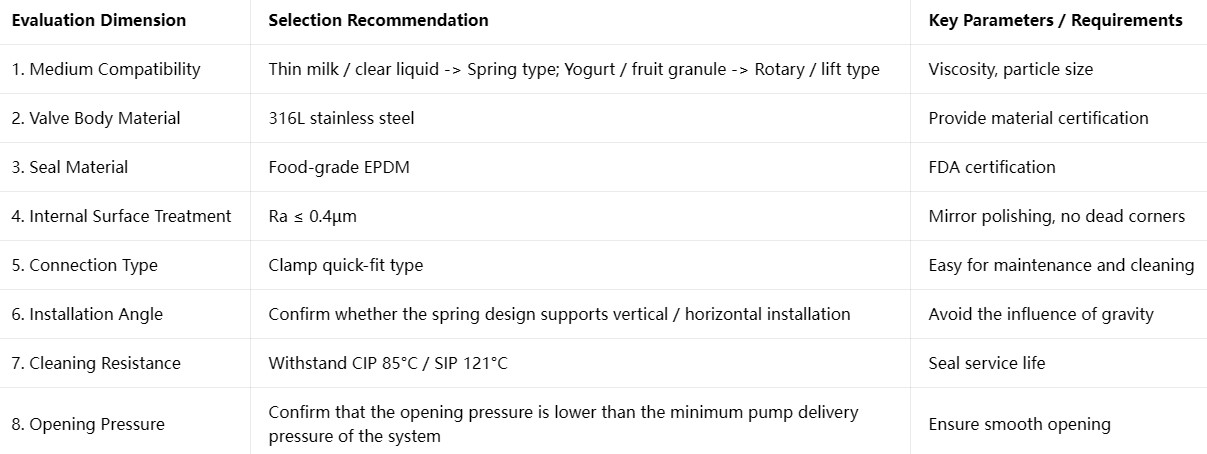
Low Viscosity: Such as fresh milk, skim milk, whey. Standard spring-loaded check valves are generally suitable.
High Viscosity/Semi-Solid: Such as yogurt, stirred yogurt, cream, cheese curds. A structure with a large flow orifice, low resistance, and weak spring
force (to avoid shearing) must be selected, such as a lift-type or guide-frame design, to prevent the media from clogging or damaging the valve
disc due to poor flow.
Containing Particulates: Such as fruit yogurt (containing fruit pieces). Standard check valves may jam, leading to seal failure. In this case, a swing
check valve or a specially designed ball check valve may need to be considered.
Temperature:
Ambient temperature: 4°C
Pasteurization: 72-85°C
CIP cleaning: 80-95°C
SIP sterilization: 121-140°C
Confirm that the sealing rings and spring materials inside the valve body must withstand the aforementioned maximum temperature.
Step 2: Choosing the Correct Internal Structure
Dairy check valves mainly have the following internal structures, which must be selected based on the characteristics of the medium:
Spring/Lift Type: Most commonly used. An internal stainless steel spring pushes the valve disc to close. Advantages include rapid response and
installation at any angle. Suitable for most low-viscosity, clean dairy products (such as pasteurized milk and UHT milk).
Swing Type: The valve disc rotates to open like a door. Advantages include low flow resistance and the ability to pass larger particles. Suitable for
media containing particles or high viscosity (such as processed yogurt).
Ball Type: Utilizes a stainless steel ball that rolls to open under medium pressure. Advantages include excellent sealing, but it is easily affected by
gravity and usually can only be installed horizontally. Suitable for aseptic filling ports that are extremely sensitive to backflow.
Step 3: Determining the Material and Sealing Rating
Valve Body Material: 316L stainless steel must be selected. Nitric acid and alkali solutions commonly used in dairy product CIP cleaning have the
least corrosive effect on 316L. A material certification report is required.
Sealing Material: EPDM (ethylene propylene diene monomer rubber) is preferred. EPDM is resistant to hot water, steam, and alkalis, making it the
gold standard for CIP/SIP environments in dairy products. It must comply with FDA 21 CFR 177.2600 standards.
Spring Material: Must be 316 stainless steel to ensure it will not break or rust under repeated high-temperature cleaning and corrosive media.
Surface Polishing: All surfaces in contact with milk must have a roughness of Ra ≤ 0.8μm, ideally Ra ≤ 0.4μm. This prevents fat globules and
proteins from adhering and forming milk residue.
Step 4: Focus on Connection and Installation MethodsClamp Quick-Connect: Highly recommended. Internal components of the check valve (such as springs, valve discs, and gaskets) are consumables;
clamp connections allow for quick disassembly and replacement, reducing downtime.
Welded:If used for permanent piping in a sterile area, and you are very confident that the internal components will not fail, a welded connection
can be chosen. However, it is generally not recommended because cutting the piping is too costly if the internal seal is damaged.
Installation Direction and Drainage:
Note the flow direction arrows marked on the valve body.
Ensure that after installation, the valve body can be completely drained without any liquid accumulation. Some designs will have a drain port at
the lowest point of the valve body.
Step 5: Verify Standards and Compliance
The dairy industry typically has strict entry requirements. When selecting equipment, verify the following certifications:
3A Hygiene Standard: 3A certification is almost mandatory if used for US standard or export dairy equipment.
EHEDG Certification: European hygiene equipment design certification, ensuring the valve is easy to clean.
Mirror Polishing: GMP-compliant internal surface treatment.
Summarize