


| Quantity: | |
|---|---|
Laboratory Nano Colloid Mill for Cosmetic Cream Production is available in benchtop, standing, and high-shear models, catering to small laboratory processing volumes. Materials include 304 and 316L stainless steel, and the mill features nano-level grinding, high-shear emulsification, homogeneous and fine texture, easy cleaning, and corrosion resistance.
JONENG


Laboratory Nano Colloid Mill for Cosmetic Cream Production is available in benchtop, standing, and high-shear models, catering to small laboratory processing volumes. Materials include 304 and 316L stainless steel, and the mill features nano-level grinding, high-shear emulsification, homogeneous and fine texture, easy cleaning, and corrosion resistance.
Working Principles

During operation, the Laboratory Nano Colloid Mill for Cosmetic Cream Production uses a motor-driven high-speed rotating rotor to feed material into the grinding chamber. A tiny gap forms between the rotor and the stator, generating intense shearing, friction, and impact forces that rapidly pulverize, homogenize, and emulsify cosmetic creams, lotions, or essential oil mixtures. The material repeatedly passes through the gap between the grinding discs during circulation, continuously refining the particles to form a uniform, delicate, and smooth nano-sized paste. The grinding disc gap and rotation speed are adjustable to control the finished product's particle size, viscosity, and emulsification effect, meeting the needs of small-batch, fine-production in the laboratory.
| Capacity | 100–2000 kg/h |
| Motor Power | 5.5–45 kW |
| Voltage | 220V / 380V / 415V / Custom |
| Frequency | 50 Hz / 60 Hz |
| Rotational Speed | 2800–3600 rpm |
| Grinding Fineness | 2–50 μm (adjustable) |
| Material (Product Contact) | SS304 / SS316L |
| Housing Material | Stainless Steel |
| Grinding Method | Rotor–Stator Colloid Grinding |
Designed with a high-precision rotor–stator system that ensures uniform particle size reduction, delivering smooth and consistent peanut butter texture while maintaining natural flavor and nutritional value.
Fully automatic operation with continuous feeding capability improves production efficiency, reduces manual labor, and ensures stable processing performance during long-time industrial food manufacturing.
Food-grade stainless steel construction provides excellent corrosion resistance, easy cleaning, and full compliance with hygienic standards required in peanut butter and nut paste processing industries.
Adjustable grinding clearance allows flexible control of fineness, enabling the machine to handle different nut materials, viscosities, and product requirements with reliable repeatability.
Integrated cooling system effectively controls processing temperature, preventing overheating, protecting product quality, and extending equipment service life during high-speed continuous grinding operations.
Compact structure with stable base design minimizes vibration and noise, ensuring safe operation, easy installation, and long-term mechanical stability in automated food processing lines.
Colloid Mill is widely used in road engineering, building materials, and chemical industries. For example, it is used in highway maintenance to produce emulsified asphalt, in the waterproofing materials industry to prepare waterproof coating emulsions, and in the chemical field for the industrial processing and formulation of asphalt-based functional emulsions.
Working Principles
During operation, the Laboratory Nano Colloid Mill for Cosmetic Cream Production uses a motor-driven high-speed rotating rotor to feed material into the grinding chamber. A tiny gap forms between the rotor and the stator, generating intense shearing, friction, and impact forces that rapidly pulverize, homogenize, and emulsify cosmetic creams, lotions, or essential oil mixtures. The material repeatedly passes through the gap between the grinding discs during circulation, continuously refining the particles to form a uniform, delicate, and smooth nano-sized paste. The grinding disc gap and rotation speed are adjustable to control the finished product's particle size, viscosity, and emulsification effect, meeting the needs of small-batch, fine-production in the laboratory.
Feature and Specification
| Capacity | 100–2000 kg/h |
| Motor Power | 5.5–45 kW |
| Voltage | 220V / 380V / 415V / Custom |
| Frequency | 50 Hz / 60 Hz |
| Rotational Speed | 2800–3600 rpm |
| Grinding Fineness | 2–50 μm (adjustable) |
| Material (Product Contact) | SS304 / SS316L |
| Housing Material | Stainless Steel |
| Grinding Method | Rotor–Stator Colloid Grinding |
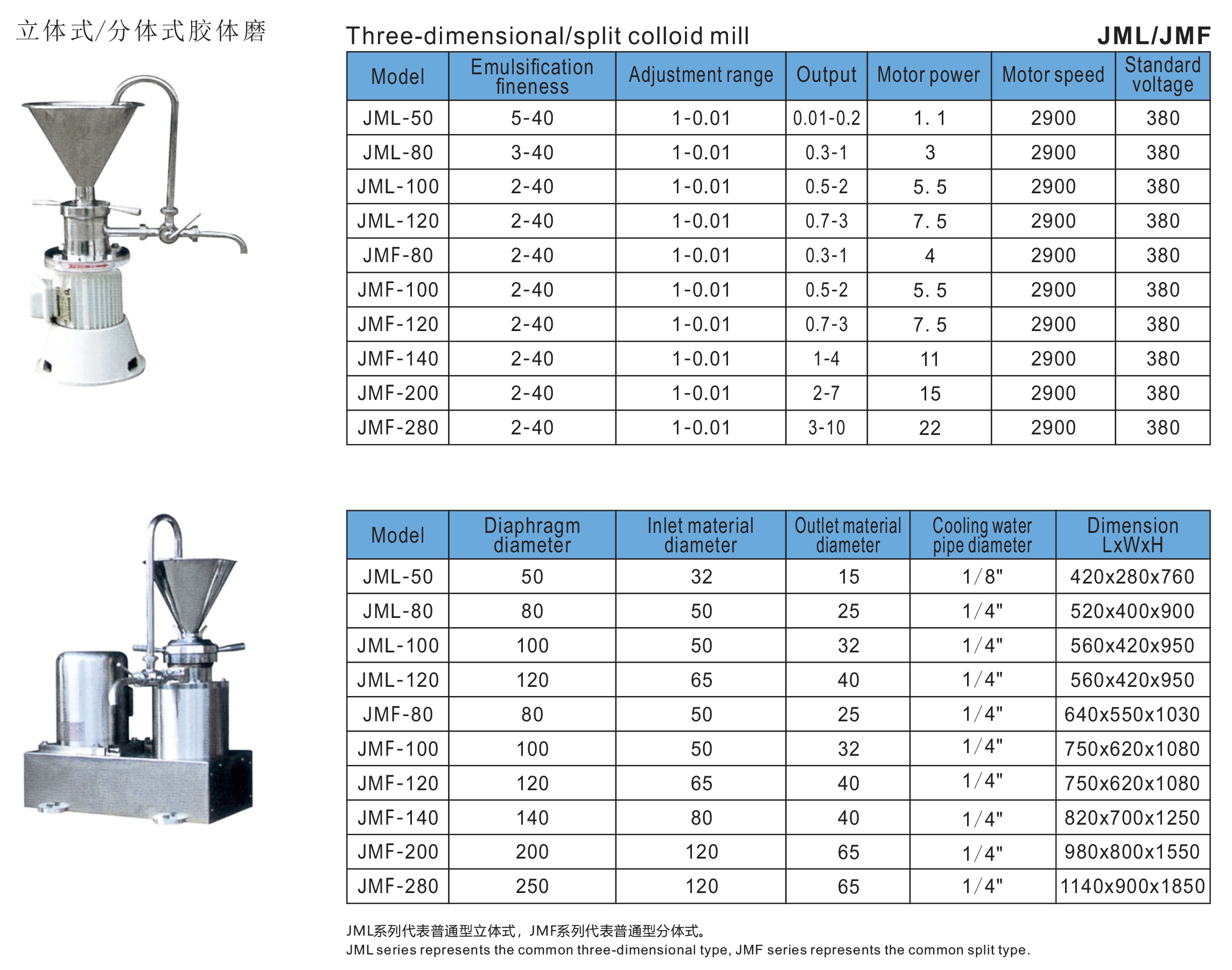
Stainless Steel colloid mill Specification Chart
Features
Designed with a high-precision rotor–stator system that ensures uniform particle size reduction, delivering smooth and consistent peanut butter texture while maintaining natural flavor and nutritional value.
Fully automatic operation with continuous feeding capability improves production efficiency, reduces manual labor, and ensures stable processing performance during long-time industrial food manufacturing.
Food-grade stainless steel construction provides excellent corrosion resistance, easy cleaning, and full compliance with hygienic standards required in peanut butter and nut paste processing industries.
Adjustable grinding clearance allows flexible control of fineness, enabling the machine to handle different nut materials, viscosities, and product requirements with reliable repeatability.
Integrated cooling system effectively controls processing temperature, preventing overheating, protecting product quality, and extending equipment service life during high-speed continuous grinding operations.
Compact structure with stable base design minimizes vibration and noise, ensuring safe operation, easy installation, and long-term mechanical stability in automated food processing lines.
Application
Colloid Mill is widely used in road engineering, building materials, and chemical industries. For example, it is used in highway maintenance to produce emulsified asphalt, in the waterproofing materials industry to prepare waterproof coating emulsions, and in the chemical field for the industrial processing and formulation of asphalt-based functional emulsions.