

Views: 0 Author: Site Editor Publish Time: 2026-05-20 Origin: Site


In food processing plants, the core of cleaning and maintenance procedures for sanitary stopcock valves is establishing a complete system from daily cleaning to periodic maintenance. Specific operating procedures and standards need to be developed based on usage frequency, material residue levels, and equipment design.
Overview of Sanitary Stopcock Valve Cleaning and Maintenance Procedures in Food Processing Plants
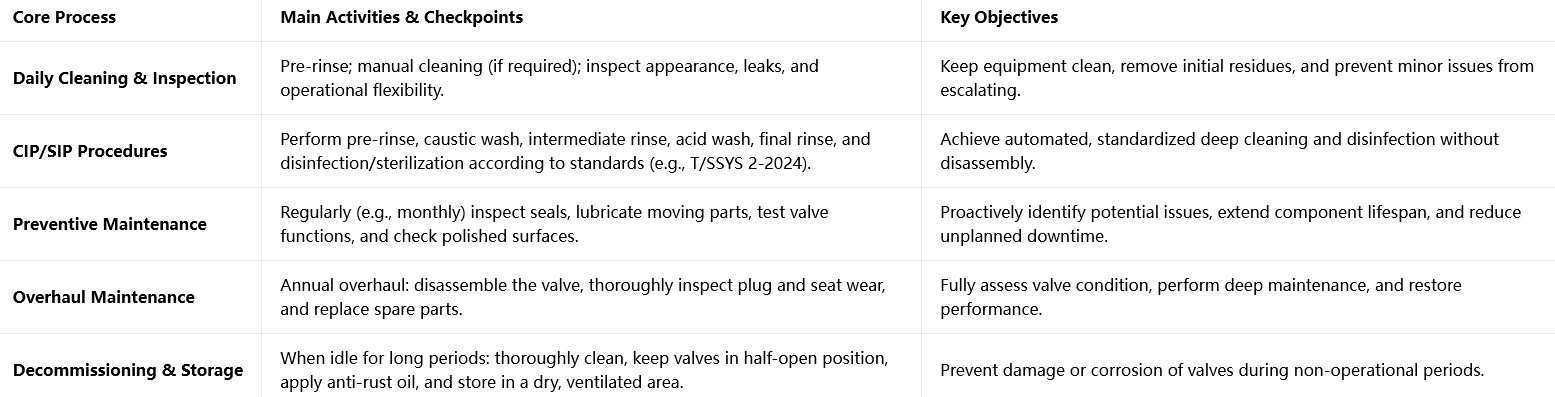
A complete system typically includes the following four key components, detailed in the Standard Operating Procedure (SOP).
Core Principles – Guiding All Practices
Timeliness: Cleaning is most effective after production, while the equipment is still warm and the material has not dried and scaled.
Thoroughness: Ensure that the cleaning solution or disinfectant flows through all surfaces inside the valve that come into contact with the product, including the valve core, seat, and other cavities.
Verifiable: Key parameters (such as time, temperature, concentration, and flow rate) of the entire process, especially the CIP/SIP procedure, must be recorded and archived for future reference to ensure the effectiveness of each cleaning.
Compatibility: All selected cleaning agents, disinfectants, and lubricants must be fully compatible with the valve material (such as 316L stainless steel, EPDM/PTFE seals) to avoid corrosion or damage.
Below is a detailed analysis of the four core procedures mentioned above.
Daily Inspection and Manual Cleaning
This is the most basic and frequent step, usually performed before and after each production shift.
Pre- and Post-Production Inspection Checklist
Visual Inspection: Confirm that the outer surface of the valve is free of obvious stains, rust, wear, or signs of material leakage.
Status Verification: Confirm the valve is in the correct open or closed position.
Operational Flexibility: Gently rotate the handle by hand to check for smooth rotation without jamming. Ensure single-person operation without the aid of a lever.
Manual Cleaning (If Disassembly and Washing Required)
Disassembly: Refer to the manufacturer's guide to disassemble the valve body and separate removable components such as the valve core and sealing rings.
Soaking and Scrubbing: Soak the disassembled components in a food-grade cleaning agent (such as a mild alkaline cleaning solution). Manually clean all components with a soft brush, especially hard-to-reach corners.
Rinsing and Drying: Rinse thoroughly with clean water and ensure the valve is completely dry inside and out.
CIP/SIP Deep Cleaning and Disinfection Procedure
When the production line is operating at a large scale and continuously, CIP/SIP is the most effective and standard cleaning method. This procedure typically follows industry-standard steps.
CIP (In-Situ Cleaning) Standard Five-Step Method
Pre-rinse (3-5 minutes): Rinse briefly with room temperature or warm water ≤50℃ at a high flow rate to remove most residual materials. Alkaline Wash (15-30 minutes): Circulate a 75-85℃ sodium hydroxide (NaOH) solution (concentration 1.0%-2.0%) to remove organic matter such as fats and proteins.
Intermediate Rinse (5-10 minutes): Rinse thoroughly with clean water until the pH of the effluent is neutral.
Acid Wash (15-20 minutes) (as needed): Periodically (e.g., weekly) circulate a 60-70℃ nitric acid or phosphoric acid solution to dissolve scale, milk stones, and other inorganic salt deposits.
Final Rinse: Rinse thoroughly with purified water that meets production requirements, ensuring no cleaning agent residue remains.
SIP Sterilization - Killing Microorganisms
Steam Sterilization: Maintaining high-temperature saturated steam (e.g., 121-140℃) for a period of time is one of the most common and reliable methods in the food industry.
Chemical Sterilization: Circulate a disinfectant solution such as peracetic acid (PAA, 100-200ppm) or hydrogen peroxide for 10-15 minutes. Suitable for certain applications where high temperatures are not permitted.
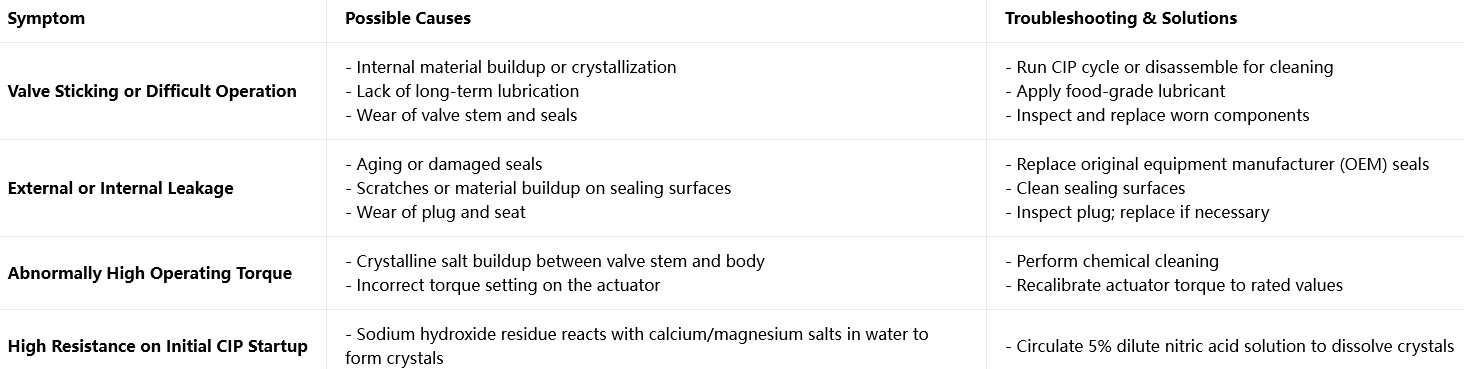
Troubleshooting Common Problems: In operation and maintenance, timely resolution of minor issues can prevent major failures.
Preventative Maintenance and Care
To ensure long-term reliable valve operation, a planned maintenance system must be established.
Regular Inspections (Monthly/Quarterly): Primarily check sealing performance, flexibility of moving parts, torque, and stem seal.
Critical Component Maintenance (Annual/As Needed): Replace all seals, inspect valve core for wear (maximum scratch depth ≤ 0.1mm), and clean the valve body interior.
Selecting Appropriate Lubricants/Seals: Always use food-grade grease, and prioritize original equipment manufacturer (OEM) or equivalent seals to ensure compatibility and hygiene.
Establish Traceable Maintenance Records: Record the time, personnel, content, and results of each cleaning, disinfection, and component replacement to facilitate future quality audits and fault analysis.