
Views: 0 Author: Site Editor Publish Time: 2026-05-14 Origin: Site


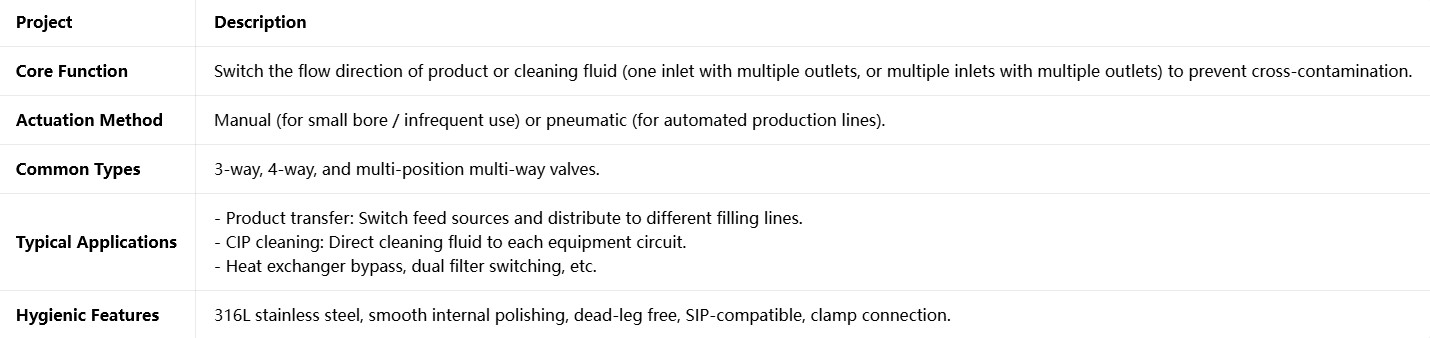
The core function of a stainless steel sanitary directional valve is to switch the flow direction of materials in the pipeline according to instructions. You can think of it as an "intelligent traffic dispatcher" on the production line, precisely controlling the material flow to achieve various complex process flows.
I. Core Advantages of Stainless Steel Sanitary Plug Valves

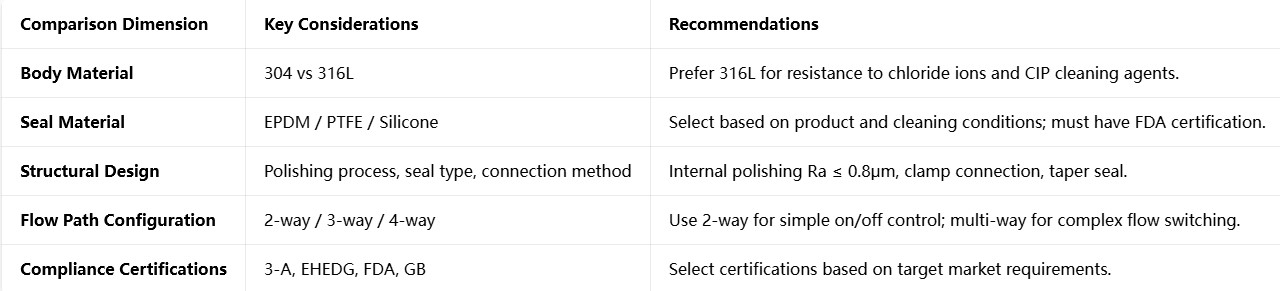
Material Selection Recommendations: 304 stainless steel is recommended for general media; 316L is recommended for chlorine-containing or high-cleanliness requirements. Common sealing materials include EPDM (general purpose), PTFE (high viscosity/strong corrosion), and silicone rubber (high purity).
II. Working Principle of Manual Sanitary Plug Valve
Core Action: Rotating the handle 90° changes the direction of the internal plug channel.
Handle parallel to the pipe → Flow open
Handle perpendicular to the pipe → Flow closed
Multi-port Applications: Three-way/four-way valves can achieve flow direction switching, diversion, and merging.
Production Line Functions: Used for material flow control, path switching, and CIP cleaning fluid diversion; the tapered seal has a "wiping" self-cleaning function.
III. Key Comparison Points for Valves Used in Food Processing
IV. Cleaning and Maintenance Procedures (CIP/SIP + Manual)
1. Daily Inspection and Manual Cleaning: Visually inspect the external surfaces, for leaks, and operational flexibility before and after production.
Manual Disassembly and Cleaning: Disassemble the valve core and seals → Scrub with a soft brush dipped in food-grade cleaning agent → Rinse thoroughly with clean water → Dry.
2. CIP Standard Procedure (Five-Step Method)
3. SIP Sterilization: Saturated steam 121-140℃, or peracetic acid (100-200ppm) circulation.
4. Preventive Maintenance: Monthly: Check seals, lubrication, and torque.
Annual: Disassemble and overhaul, replace seals, and check valve core wear (scratches ≤0.1mm).
V. Beverage Application Selection Guide: Four-Step Selection Method: Define basic parameters: media corrosivity, temperature, pressure, flow rate, CIP/SIP requirements, and connection diameter.
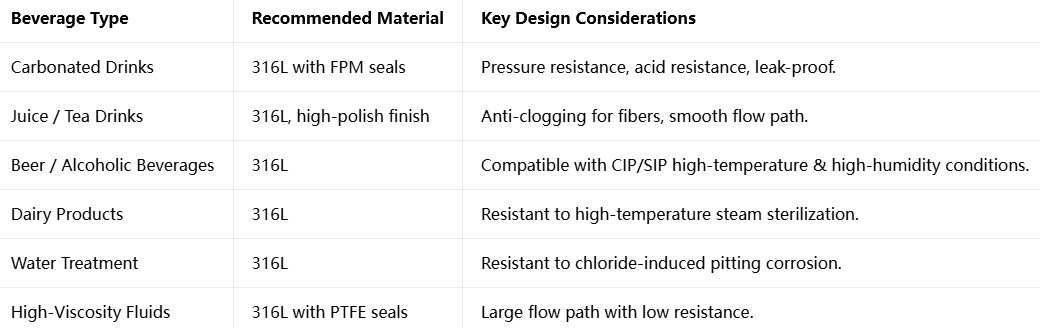
Select Material: 316L + chrome-plated valve core (recommended for juices, carbonated beverages, beer, dairy products, and CIP systems)
304 (economical, water treatment, and neutral beverages)
Focus on Hygiene Design: Polishing Ra≤0.8μm, no dead-angle flow channels, quick-release clamps, and the "wiping" effect of tapered seals.
Verify Compliance Standards: 3-A / EHEDG / FDA / ASME BPE.
Specific Recommendations for Different Beverages
VI. Function of Stainless Steel Sanitary Directional Control Valves