



1. What pumps require a speed reducer?
Pumps requiring speed reducers are primarily driven by a high-speed, low-torque prime mover (motor/engine):
Low-speed, high-torque pumps
Pumps requiring precise speed control and reduced impact
Typical pump types requiring speed reducers:
Polygonative displacement pumps (most common)
Gear pumps, screw pumps, piston pumps, vane pumps
Characteristics: Flow rate is directly proportional to speed; must operate stably at low speed, otherwise, wear will be high,
noise will be high, and lifespan will be short
Some centrifugal pumps/mixed-flow pumps/axial-flow pumps
Large flow rate, low head, requiring low-speed, high-torque start-up (e.g., large sewage pumps, mud pumps, slurry pumps)
Or requiring multi-stage speed control (variable frequency converter + speed reducer combination)
II. What is the function of a speed reducer?
A speed reducer is a mechanical device that combines speed reduction, torque amplification, and transmission. Its core functions are:
Speed Reduction:Reducing the high speed of the motor/engine (e.g., 1450/2900 rpm) to the low speed required by the pump (e.g., tens to hundreds of rpm).
Torque Increase: As the speed decreases, the torque is proportionally amplified (torque ≈ power × 9550 / speed), meeting the requirements for heavy-load pump start-up and operation.
Changing Transmission Direction/Type: Direct drive, right-angle drive (bevel gears), multi-axis output, etc.
Buffering and Overload Protection:Some speed reducers with clutches/hydraulic couplings can buffer starting shocks, protecting the motor and pump.
Speed Regulation (with Variable Frequency Drive/Gear Shifting):Multi-stage speed reducers + variable frequency drives achieve more precise speed regulation over a wider range.
Simply put:Transforming a "high-speed, low-power" motor into a "low-speed, high-power" pump power source.
III. What benefits can a speed reducer bring to a pump?
1. Reduce pump speed and extend lifespan: Avoids wear, cavitation, vibration, and noise caused by high speeds, especially for precision
positive displacement pumps such as gear pumps, screw pumps, and piston pumps, extending lifespan several times.
2. Increase output torque for easy load start-up: Solves starting difficulties for pumps handling large flow, high viscosity, and solid media,
preventing motor overload and burnout.
3. Stabilize flow and pressure: Positive displacement pump flow rate ≈ speed × displacement. The reducer makes the speed more stable,
with smaller flow/pressure fluctuations, suitable for metering, conveying, and high-pressure conditions.
4. Adapt to different installation spaces: Right-angle reducers, hollow shaft reducers, etc., allow for flexible placement of the motor and pump,
saving space.
5. Protect the motor and pump: The gears/bearings of the reducer can buffer impacts, and some have overload protection,
preventing direct damage to the motor in case of pump seizure.
6. Widen the speed range: A reducer + frequency converter can achieve full-condition coverage from low-speed high torque
to high-speed low torque, which is more energy-efficient and stable than a simple frequency converter.
IV. What are the benefits of having a speed reducer on a pump?
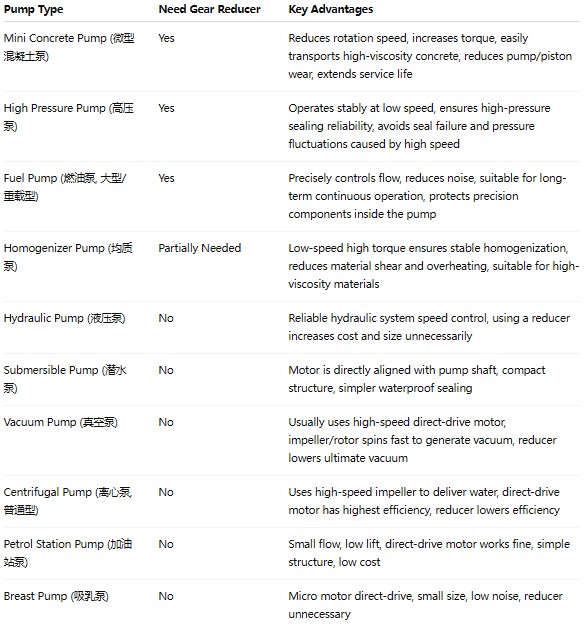
V. When is a speed reducer not needed?
1. Pumps are inherently suitable for high-speed operation: Centrifugal pumps, vacuum pumps, submersible pumps,
and small gear pumps (low flow rate) offer higher efficiency at high speeds and can be directly connected to the motor.
2. Motor speed matches pump rated speed: The motor's rated speed (1450/2900 rpm) equals the pump's optimal operating speed,
eliminating the need for a speed reducer.
3. Suitable for low flow rate, low head, and light load conditions: For applications such as small household pumps, laboratory pumps,
gas station pumps, and breast pumps, where torque requirements are low, direct connection is simpler.
4. Existing speed control methods: Hydraulic pumps rely on the hydraulic system for speed control, while variable frequency pumps rely
on a frequency converter (and the motor torque is sufficient), eliminating the need for a speed reducer.
5. Space/cost constraints: For micro-pumps and portable pumps, a speed reducer would increase size, weight, and cost,
making it counterproductive.