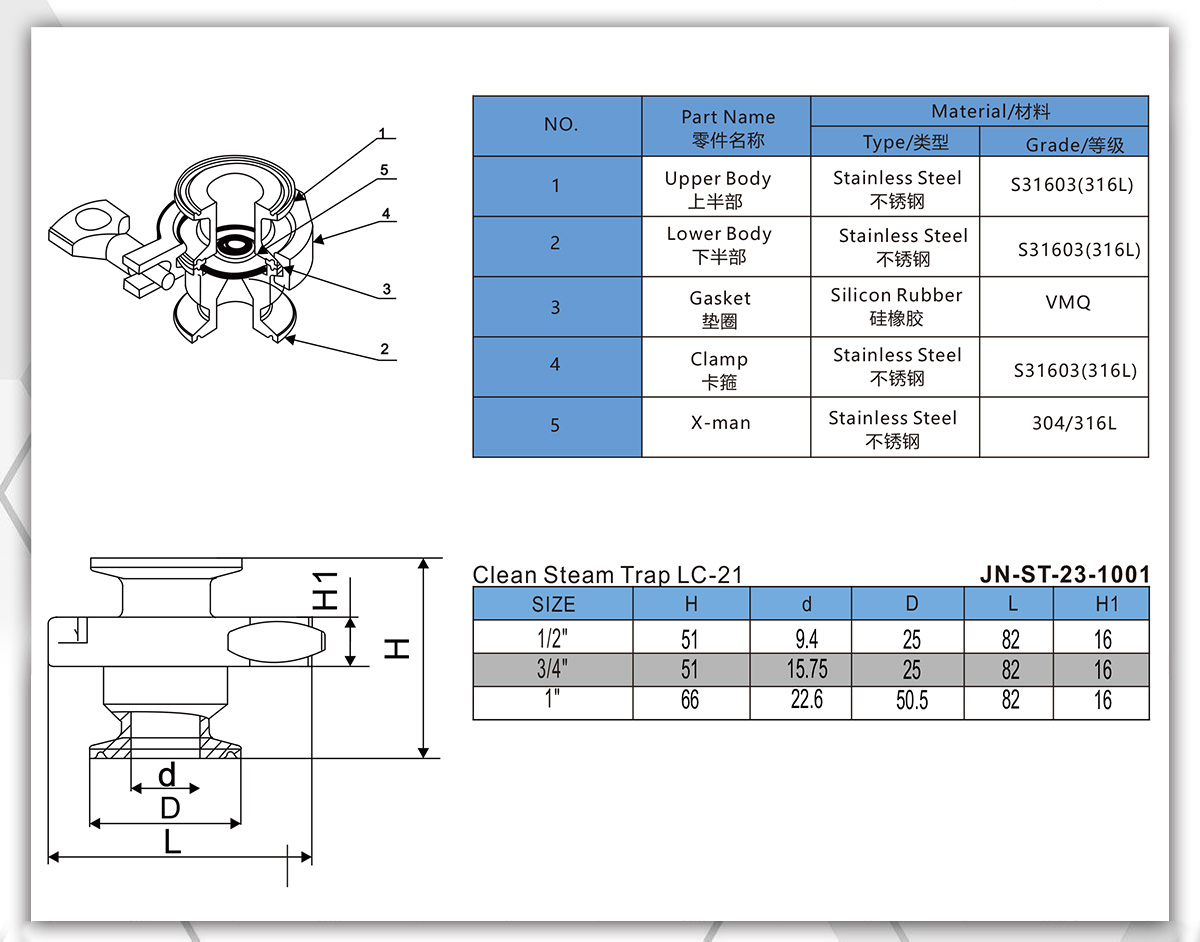
STAINLESS STEEL Float Valve Clamp On Manufacturer Testing Steam Trap
steam trap are available in threaded and flanged types, with various sizes and pressure ratings. They are high-temperature and corrosion-resistant, offer sensitive opening and closing, and provide stable drainage, making them suitable for steam systems.
Working Principles

The steam trap applications, works by using a float and valve mechanism to automatically drain condensate. When condensate forms in the steam pipe, the float rises with the water level, opening the valve and draining the condensate. As the condensate drains and the water level drops, the float falls back down, automatically closing the valve to prevent steam leakage. This steam trap can also be installed externally via clamps for easy testing and maintenance, while ensuring a continuous steam supply and efficient energy utilization in the piping system.
Stainless Steel Steam Ttap Specification Chart
| Body Material | SS304 / SS316L Stainless Steel |
| Connection Type | Clamp / Threaded / Welded |
| Nominal Size | DN15 – DN50 (1/2" – 2") |
| Design Pressure | PN16 / PN25 / PN40 |
| Working Pressure | 16 – 40 bar |
| Working Temperature | 220 – 400°C |
| Applicable Media | Saturated Steam, Condensate |
| Surface Finish | Ra ≤ 0.8 μm |
| Standards | DIN / SMS / ISO / 3A |
Features
High-quality stainless steel construction ensures long-lasting durability and resistance to corrosion in various industrial environments.
Ball float mechanism provides precise condensate discharge and maintains consistent steam system performance.
Thermostatic control enables automatic adjustment to varying steam pressures and temperatures for efficient operation.
Wireless monitoring capability allows real-time performance tracking and predictive maintenance alerts.
Compact and hygienic design facilitates easy installation, cleaning, and integration into sanitary steam systems
Application
The steam traps are widely used in food processing, pharmaceutical, chemical, and paper industries. In food plants, they remove condensate from boilers and heating pipes, ensuring uniform steam heating, improving production efficiency, and preventing equipment corrosion and water hammer.