



| Quantity: | |
|---|---|
JONENG


steam trap are available in threaded and flanged types, with various sizes and pressure ratings. They are high-temperature and corrosion-resistant, offer sensitive opening and closing, and provide stable drainage, making them suitable for steam systems.

The stainless steel steam trap automatically opens and closes based on the velocity and pressure difference between condensate and steam. When condensate enters the valve body, the low-velocity liquid pushes the valve disc open, quickly expelling condensate and air. When steam or superheated steam arrives, the high-speed flow creates a momentary pressure difference above the valve disc, causing it to close tightly and preventing steam leakage. As the steam cools and condensate forms, the pressure difference decreases, and the valve reopens. The valve operates in a continuous cycle and is suitable for high-temperature, high-pressure, and superheated steam pipelines. It features a simple structure and strong resistance to various working conditions.
| Body Material | SS304 / SS316L Stainless Steel |
| Connection Type | Clamp / Threaded / Welded |
| Nominal Size | DN15 – DN50 (1/2" – 2") |
| Design Pressure | PN16 / PN25 / PN40 |
| Working Pressure | 16 – 40 bar |
| Working Temperature | 220 – 400°C |
| Applicable Media | Saturated Steam, Condensate |
| Surface Finish | Ra ≤ 0.8 μm |
| Standards | DIN / SMS / ISO / 3A |
Manufactured from stainless steel 317, providing superior corrosion resistance in superheated water and high-temperature steam conditions.
Thermodynamic disc operating principle ensures fast response, reliable condensate discharge, and effective prevention of live steam loss.
Compact and robust valve structure supports stable performance under fluctuating pressure and temperature test environments.
Suitable for superheated water testing systems, handling rapid temperature changes without distortion or sealing failure.
Simple internal design reduces maintenance frequency and ensures long service life in demanding industrial applications
The steam trap is widely used in chemical, power, oil refining, textile, and district heating systems. For example, in steam tracing pipelines of chemical plants, it continuously drains condensate to prevent water accumulation and water hammer; in power plant steam transmission systems, it ensures long-term stable equipment operation and reduces energy consumption.
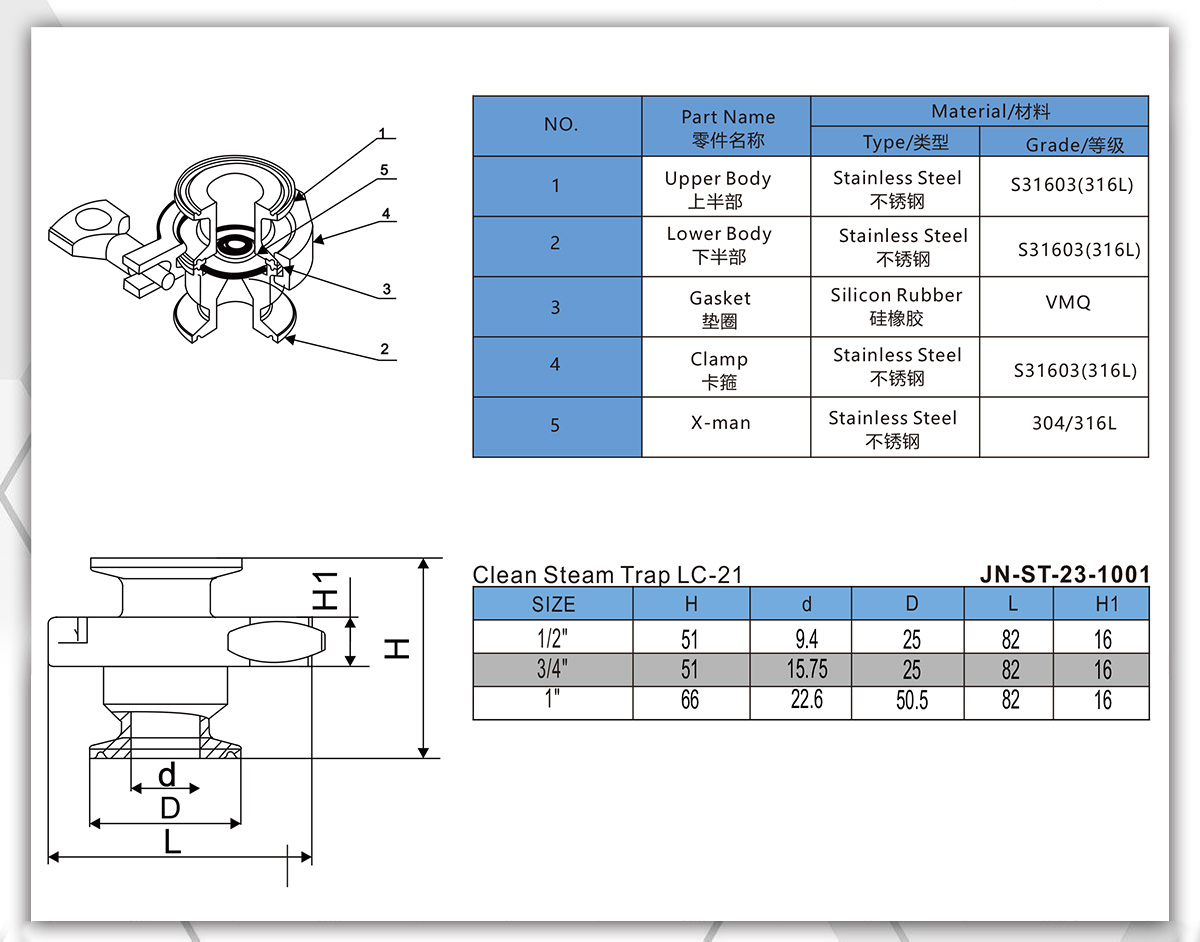
Working Principles
The stainless steel steam trap automatically opens and closes based on the velocity and pressure difference between condensate and steam. When condensate enters the valve body, the low-velocity liquid pushes the valve disc open, quickly expelling condensate and air. When steam or superheated steam arrives, the high-speed flow creates a momentary pressure difference above the valve disc, causing it to close tightly and preventing steam leakage. As the steam cools and condensate forms, the pressure difference decreases, and the valve reopens. The valve operates in a continuous cycle and is suitable for high-temperature, high-pressure, and superheated steam pipelines. It features a simple structure and strong resistance to various working conditions.
Feature and Specification
| Body Material | SS304 / SS316L Stainless Steel |
| Connection Type | Clamp / Threaded / Welded |
| Nominal Size | DN15 – DN50 (1/2" – 2") |
| Design Pressure | PN16 / PN25 / PN40 |
| Working Pressure | 16 – 40 bar |
| Working Temperature | 220 – 400°C |
| Applicable Media | Saturated Steam, Condensate |
| Surface Finish | Ra ≤ 0.8 μm |
| Standards | DIN / SMS / ISO / 3A |
Features
Manufactured from stainless steel 317, providing superior corrosion resistance in superheated water and high-temperature steam conditions.
Thermodynamic disc operating principle ensures fast response, reliable condensate discharge, and effective prevention of live steam loss.
Compact and robust valve structure supports stable performance under fluctuating pressure and temperature test environments.
Suitable for superheated water testing systems, handling rapid temperature changes without distortion or sealing failure.
Simple internal design reduces maintenance frequency and ensures long service life in demanding industrial applications
Application
The steam trap is widely used in chemical, power, oil refining, textile, and district heating systems. For example, in steam tracing pipelines of chemical plants, it continuously drains condensate to prevent water accumulation and water hammer; in power plant steam transmission systems, it ensures long-term stable equipment operation and reduces energy consumption.