



| Quantity: | |
|---|---|
JONENG


steam trap are available in threaded and flanged types, with various sizes and pressure ratings. They are high-temperature and corrosion-resistant, offer sensitive opening and closing, and provide stable drainage, making them suitable for steam systems.

This steam trap automatically controls its opening and closing by utilizing a stainless steel float that rises and falls with the condensate level. When condensate enters the valve body, the rising level causes the float to rise, opening the drain outlet to discharge the condensate. When steam enters, the float sinks due to the lower density of steam, closing the drain outlet to prevent steam leakage. For superheated conditions, a specially designed structure reduces the impact of flash evaporation, ensuring stable separation and discharge of condensate even in superheated environments above 100°C, maintaining efficient system operation.
| Body Material | SS304 / SS316L Stainless Steel |
| Connection Type | Clamp / Threaded / Welded |
| Nominal Size | DN15 – DN50 (1/2" – 2") |
| Design Pressure | PN16 / PN25 / PN40 |
| Working Pressure | 16 – 40 bar |
| Working Temperature | 220 – 400°C |
| Applicable Media | Saturated Steam, Condensate |
| Surface Finish | Ra ≤ 0.8 μm |
| Standards | DIN / SMS / ISO / 3A |
Constructed from high-quality stainless steel, offering excellent corrosion resistance and durability for superheated water and high-temperature steam applications.
Thermodynamic disc design enables rapid response to condensate and steam flow, ensuring efficient condensate discharge while minimizing live steam loss.
Suitable for superheated water testing systems, handling rapid temperature fluctuations without valve distortion or leakage.
Compact and robust structure allows easy installation in test rigs, pilot plants, or laboratory setups with reliable performance.
Simple internal mechanism reduces maintenance frequency, enhances operational reliability, and ensures long-term service life under demanding condition
This steam trap steam traps are widely used in chemical, pharmaceutical, food processing, and power plant steam systems. For example, in chemical experimental equipment, they are used in high-temperature steam tracing pipelines to promptly drain condensate, prevent water accumulation and water hammer in equipment, and improve system heat exchange efficiency and process safety.
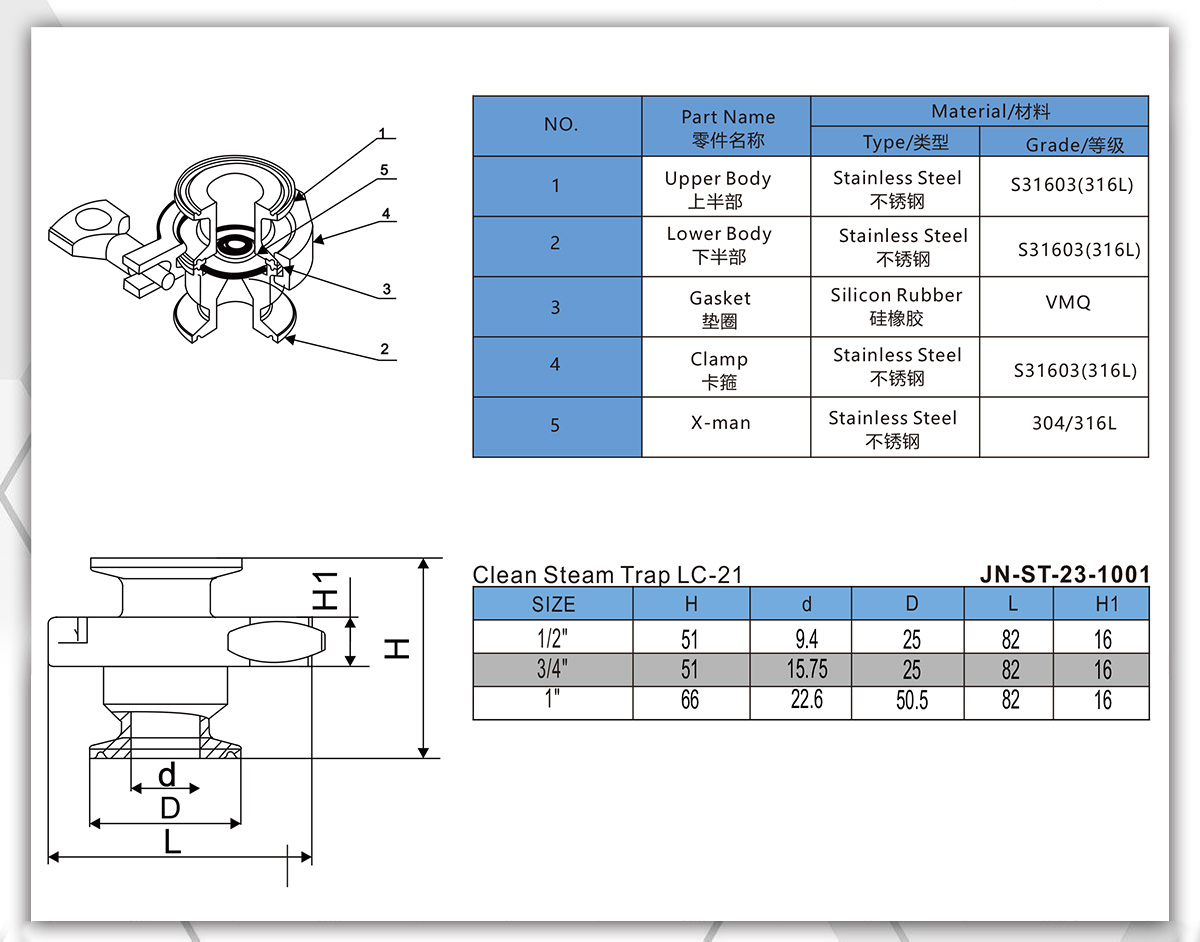
Working Principles
This 317 stainless steel thermodynamic wireless monitoring steam trap operates based on the flow rate and pressure difference between steam and condensate. When condensate and air enter the valve body, the valve plate is opened, and the condensate is quickly discharged. When high-temperature steam arrives, it creates a momentary low-pressure zone above the valve plate, causing the valve plate to close quickly and preventing steam leakage. The valve cycles periodically between opening and closing, achieving efficient condensation. The wireless monitoring module can collect data such as temperature and opening/closing status in real time and transmit it remotely for operation monitoring and energy-saving management.
Feature and Specification
| Body Material | SS304 / SS316L Stainless Steel |
| Connection Type | Clamp / Threaded / Welded |
| Nominal Size | DN15 – DN50 (1/2" – 2") |
| Design Pressure | PN16 / PN25 / PN40 |
| Working Pressure | 16 – 40 bar |
| Working Temperature | 220 – 400°C |
| Applicable Media | Saturated Steam, Condensate |
| Surface Finish | Ra ≤ 0.8 μm |
| Standards | DIN / SMS / ISO / 3A |
Features
Constructed from high-quality stainless steel, offering excellent corrosion resistance and durability for superheated water and high-temperature steam applications.
Thermodynamic disc design enables rapid response to condensate and steam flow, ensuring efficient condensate discharge while minimizing live steam loss.
Suitable for superheated water testing systems, handling rapid temperature fluctuations without valve distortion or leakage.
Compact and robust structure allows easy installation in test rigs, pilot plants, or laboratory setups with reliable performance.
Simple internal mechanism reduces maintenance frequency, enhances operational reliability, and ensures long-term service life under demanding condition
Application
This steam trap steam traps are widely used in chemical, pharmaceutical, food processing, and power plant steam systems. For example, in chemical experimental equipment, they are used in high-temperature steam tracing pipelines to promptly drain condensate, prevent water accumulation and water hammer in equipment, and improve system heat exchange efficiency and process safety.