



| Quantity: | |
|---|---|
JONENG


steam traps are available in threaded and flanged types, with various diameters to choose from. They are made of SS304 or SS316 and are suitable for short-term testing or small pipelines. They offer stable drainage, reliable operation, and easy maintenance.

The steam trap achieves automatic drainage through a float and valve mechanism. When condensate enters the valve body, the rising liquid level pushes the float upward, opening the valve and expelling condensate and air from the pipe. When steam arrives, the float descends, closing the valve to prevent steam leakage. The clamp-on design allows for installation or removal without cutting through the pipe, facilitating testing and maintenance. This valve enables efficient drainage in steam tracing, heat exchangers, and small piping systems, ensuring system thermal efficiency and operational stability.
| Body Material | SS304 / SS316L Stainless Steel |
| Connection Type | Clamp / Threaded / Welded |
| Nominal Size | DN15 – DN50 (1/2" – 2") |
| Design Pressure | PN16 / PN25 / PN40 |
| Working Pressure | 16 – 40 bar |
| Working Temperature | 220 – 400°C |
| Applicable Media | Saturated Steam, Condensate |
| Surface Finish | Ra ≤ 0.8 μm |
| Standards | DIN / SMS / ISO / 3A |
Constructed from high-quality stainless steel, offering excellent corrosion resistance and long service life in high-temperature and high-pressure steam systems.
Ball float mechanism provides precise and continuous condensate discharge while preventing live steam loss during operation.
Designed for testing and short-term monitoring, allowing accurate evaluation of steam system performance without affecting regular operations.
Compact and robust structure enables easy installation, quick maintenance, and integration into existing piping systems.
Simple internal design reduces wear, ensures reliable operation, and minimizes maintenance requirements in industrial and laboratory applications.
steam traps are widely used in food processing, dairy, pharmaceutical, and brewing industries. For example, in dairy pasteurization pipelines, they are used to drain condensate and ensure uniform heating of the steam jacket; in steam tracing pipelines of beer production lines, they enable quick installation and maintenance, improving production efficiency and process stability.
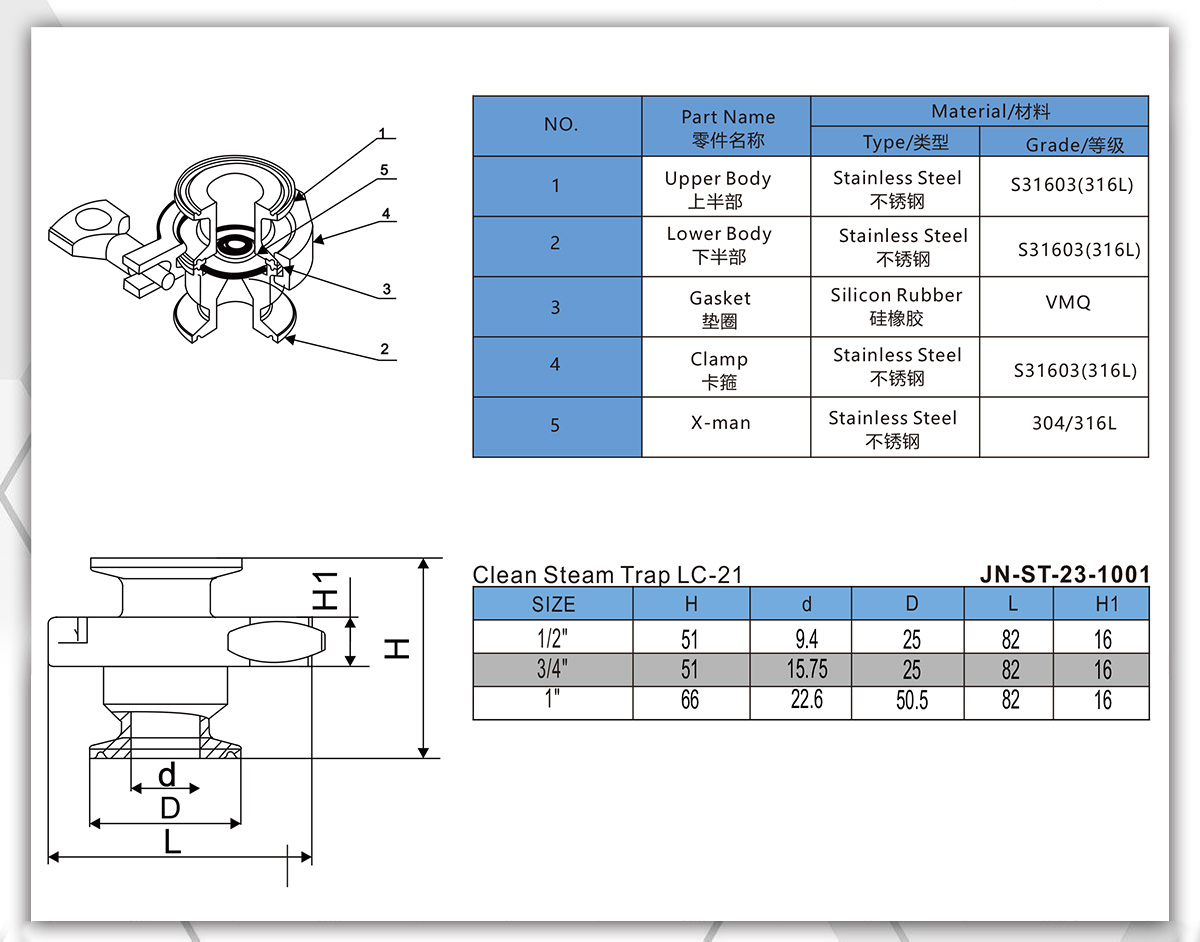
Working Principles
The steam trap achieves automatic drainage through a float and valve mechanism. When condensate enters the valve body, the rising liquid level pushes the float upward, opening the valve and expelling condensate and air from the pipe. When steam arrives, the float descends, closing the valve to prevent steam leakage. The clamp-on design allows for installation or removal without cutting through the pipe, facilitating testing and maintenance. This valve enables efficient drainage in steam tracing, heat exchangers, and small piping systems, ensuring system thermal efficiency and operational stability.
Feature and Specification
| Body Material | SS304 / SS316L Stainless Steel |
| Connection Type | Clamp / Threaded / Welded |
| Nominal Size | DN15 – DN50 (1/2" – 2") |
| Design Pressure | PN16 / PN25 / PN40 |
| Working Pressure | 16 – 40 bar |
| Working Temperature | 220 – 400°C |
| Applicable Media | Saturated Steam, Condensate |
| Surface Finish | Ra ≤ 0.8 μm |
| Standards | DIN / SMS / ISO / 3A |
Features
Constructed from high-quality stainless steel, offering excellent corrosion resistance and long service life in high-temperature and high-pressure steam systems.
Ball float mechanism provides precise and continuous condensate discharge while preventing live steam loss during operation.
Designed for testing and short-term monitoring, allowing accurate evaluation of steam system performance without affecting regular operations.
Compact and robust structure enables easy installation, quick maintenance, and integration into existing piping systems.
Simple internal design reduces wear, ensures reliable operation, and minimizes maintenance requirements in industrial and laboratory applications.
Application
steam traps are widely used in food processing, dairy, pharmaceutical, and brewing industries. For example, in dairy pasteurization pipelines, they are used to drain condensate and ensure uniform heating of the steam jacket; in steam tracing pipelines of beer production lines, they enable quick installation and maintenance, improving production efficiency and process stability.