



| Quantity: | |
|---|---|
JONENG


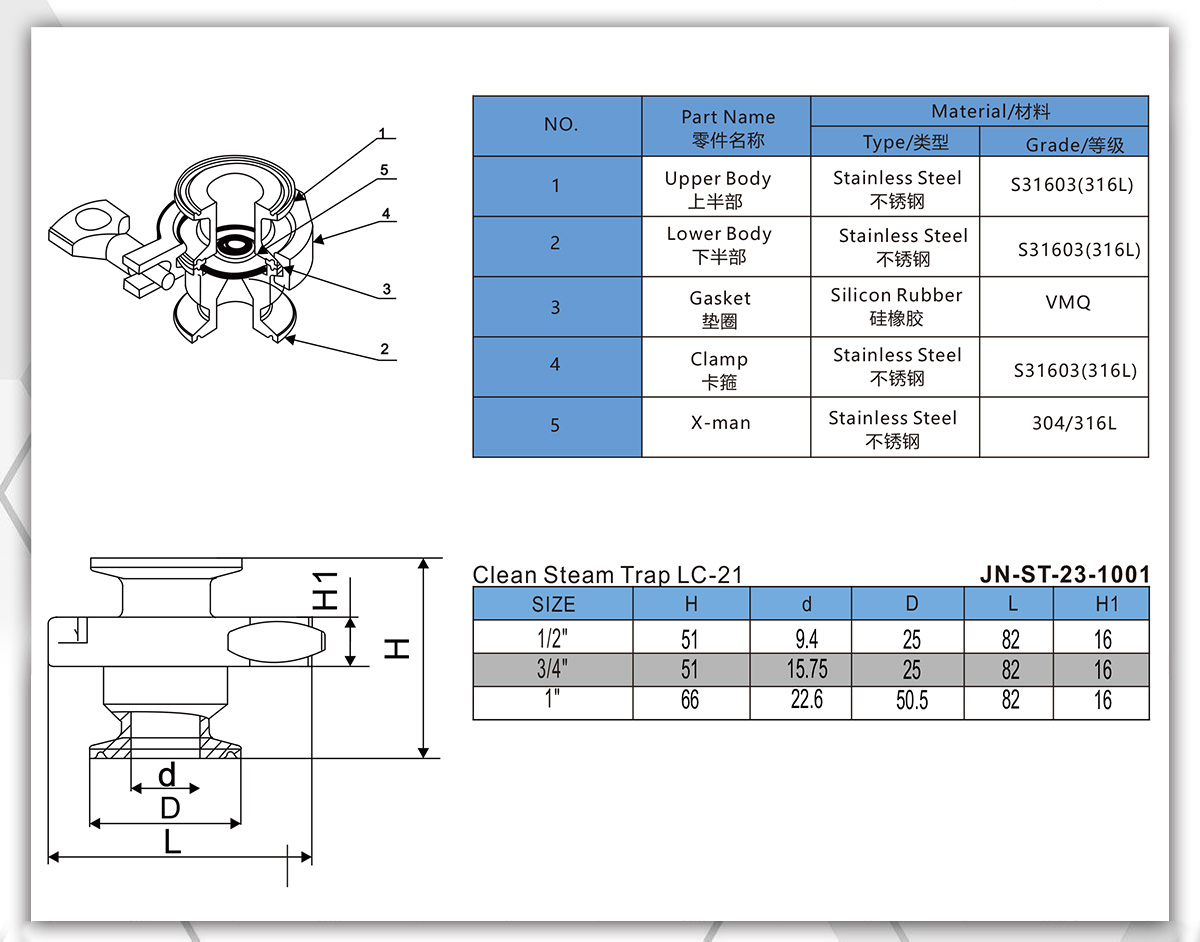
steam traps are available in threaded and flanged types, with various diameters to choose from. They are made of SS304 or SS316 and are suitable for short-term testing or small pipelines. They offer stable drainage, reliable operation, and easy maintenance.

Stainless steel steam traps rely on a float's response to changes in condensate level to achieve continuous drainage. When condensate enters the valve body, the rising level pushes the float upwards, which in turn drives the valve core to gradually open, allowing for continuous and stable condensate drainage. When steam enters or the level drops, the float falls, closing the valve and preventing steam leakage. An air venting device is typically installed inside the valve body to quickly remove non-condensable gases during startup. The test-type design facilitates online monitoring of the steam trap's operating status and is suitable for steam systems with high requirements for drainage stability and monitoring.
| Body Material | SS304 / SS316L Stainless Steel |
| Connection Type | Clamp / Threaded / Welded |
| Nominal Size | DN15 – DN50 (1/2" – 2") |
| Design Pressure | PN16 / PN25 / PN40 |
| Working Pressure | 16 – 40 bar |
| Working Temperature | 220 – 400°C |
| Applicable Media | Saturated Steam, Condensate |
| Surface Finish | Ra ≤ 0.8 μm |
| Standards | DIN / SMS / ISO / 3A |
Stainless steel body ensures high corrosion resistance and hygienic performance, suitable for demanding steam applications requiring durability, cleanliness, and long service life.
Ball float mechanism enables continuous and smooth condensate discharge, maintaining stable heat transfer efficiency without intermittent water hammer or steam loss.
Built-in air vent allows rapid removal of air and non-condensable gases during system start-up, improving heating response and overall system efficiency.
Testing design supports on-line inspection and performance verification, helping operators quickly identify normal operation, blockage, or internal leakage.
Compact structure and precise internal components simplify installation, reduce maintenance downtime, and ensure reliable operation under fluctuating pressure conditions.
steam traps are widely used in food processing, dairy, pharmaceutical, and brewing industries. For example, in dairy pasteurization pipelines, they are used to drain condensate and ensure uniform heating of the steam jacket; in steam tracing pipelines of beer production lines, they enable quick installation and maintenance, improving production efficiency and process stability.
Working Principles
Stainless steel steam traps rely on a float's response to changes in condensate level to achieve continuous drainage. When condensate enters the valve body, the rising level pushes the float upwards, which in turn drives the valve core to gradually open, allowing for continuous and stable condensate drainage. When steam enters or the level drops, the float falls, closing the valve and preventing steam leakage. An air venting device is typically installed inside the valve body to quickly remove non-condensable gases during startup. The test-type design facilitates online monitoring of the steam trap's operating status and is suitable for steam systems with high requirements for drainage stability and monitoring.
Feature and Specification
| Body Material | SS304 / SS316L Stainless Steel |
| Connection Type | Clamp / Threaded / Welded |
| Nominal Size | DN15 – DN50 (1/2" – 2") |
| Design Pressure | PN16 / PN25 / PN40 |
| Working Pressure | 16 – 40 bar |
| Working Temperature | 220 – 400°C |
| Applicable Media | Saturated Steam, Condensate |
| Surface Finish | Ra ≤ 0.8 μm |
| Standards | DIN / SMS / ISO / 3A |
Features
Stainless steel body ensures high corrosion resistance and hygienic performance, suitable for demanding steam applications requiring durability, cleanliness, and long service life.
Ball float mechanism enables continuous and smooth condensate discharge, maintaining stable heat transfer efficiency without intermittent water hammer or steam loss.
Built-in air vent allows rapid removal of air and non-condensable gases during system start-up, improving heating response and overall system efficiency.
Testing design supports on-line inspection and performance verification, helping operators quickly identify normal operation, blockage, or internal leakage.
Compact structure and precise internal components simplify installation, reduce maintenance downtime, and ensure reliable operation under fluctuating pressure conditions.
Application
steam traps are widely used in food processing, dairy, pharmaceutical, and brewing industries. For example, in dairy pasteurization pipelines, they are used to drain condensate and ensure uniform heating of the steam jacket; in steam tracing pipelines of beer production lines, they enable quick installation and maintenance, improving production efficiency and process stability.